

How to List Cybersecurity Skills in Your CV
The best way to include cybersecurity skills on your CV is to pair technical expertise with real-world outcomes, tools, and proof of your skills. A recruiter will need to get a look at what you can protect, investigate, or improve in a hurry.
Whether you are new to the field of cybersecurity or you are a seasoned IT professional looking to make a career switch, your CV should go beyond just a basic list of cybersecurity jargon. It should demonstrate the application of your knowledge to actual security problems. The correct format can make your application easier to evaluate and show the employer your knowledge of the requirements of the job.
What Technical Skills to Add in the Resume?
Concentrate on Skills Related to the Desired Position
Not all jobs in the cybersecurity field involve the same skills. A security analyst might need to have monitoring and incident investigation skills, or a penetration tester might need to know about ethical hacking and exploiting vulnerabilities. It is important to select skills based on the job opening and not from a long list found on the web.
| Skills Area | Examples to Consider |
| Network Security | Firewalls, network protocols, intrusion detection |
| Threat Analysis | Threat identification, log analysis, security monitoring |
| Vulnerability Management | Risk assessment, vulnerability scanning, remediation |
| Identity Protection | Access controls, authentication, privilege management |
| Security Tools | SIEM platforms, endpoint protection, network analysis tools |
| Governance | Security policies, risk management, compliance awareness |
This is the only list of skills even approved by CV writing service London that you can articulate with assurance. When a recruiter inquires about how you applied a specific tool, you should be able to back it up with knowledge or experience.
How to Introduce Yourself and Your Ability as a Beginner in the CV?
Back Up Your Learning with Evidence
New applicants to the industry may doubt the strength of their CV because of a lack of professional experience. However, appropriate courses, hands-on activities, personal projects, and lab projects can prove valuable knowledge of their cybersecurity skills.
Instead of writing
⨯ Cybersecurity, Networking, Linux, Ethical hacking, and Python.
Try to add context to the information!
✔ Cybersecurity Skills: Network traffic analysis, Linux fundamentals, vulnerability assessment, and basic Python scripting. Used simulated lab exercises to identify suspicious traffic and record the results.
This way, the recruiter has more information, and the section will not be too long as well.
What Can Experienced Professionals Show in Their Resume?
Go Beyond the Naming of Tools
Candidates need to demonstrate their cybersecurity skills by relating how their understanding helped to enhance security if they are experienced. Just a short list of software can fail to describe years of hands-on experience.
For example!
Less Effective – SIEM, incident response, vulnerability management, and firewall admin.
More Persuasive – Managed security alerts via SIEM, reviewed all security alerts, and assisted with the incident response process in all business systems.
If possible, provide measurable information. These might include the number of systems monitored, incidents investigated, vulnerabilities resolved, or security processes improved.
What Can Career Changers Emphasise in Their Skills Document?
Relate Past Experiences to Security
If a career changer has transferable cybersecurity skills from previous jobs, they do not come across as a complete novice. IT support, networking, software development, auditing, and systems administration skills can be helpful bases for cybersecurity.
Consider These Connections
- IT support – Troubleshooting, account management, and resolving technical issues.
- Networking – Understanding protocols, connectivity, and infrastructure.
- Software Development – Secure coding, debugging, and identifying application weaknesses.
- Auditing – Documentation, compliance checks, and risk identification should be the focus of auditing.
- System Administration – Permissions, patching, and system maintenance.
Next, discuss the ways in which you gained your security knowledge through training, certifications, projects, or practical exercises. These are tips for good writing that immediately convince a recruiter that you can bring potential to their firm.
A CV for a career change should make everything clear to the reader. It should demonstrate what you know and how you have learned, and the cybersecurity position you are pursuing.
Where to Include Cybersecurity Skills on a Resume?
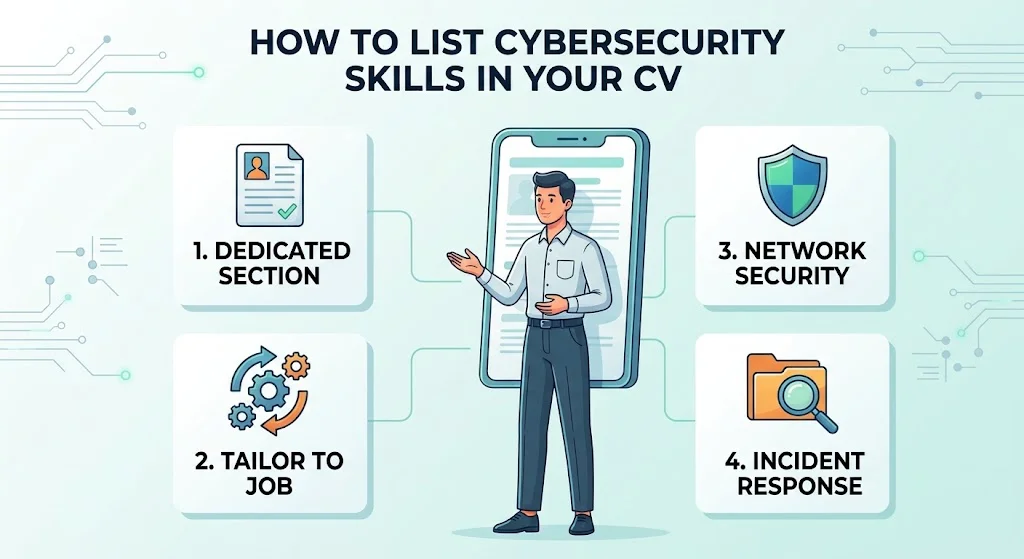
When it comes to accurate placement, it is advised that applicants include a structure that allows for rapid scanning. Applications are frequently scanned by recruiters. The relevant information on your CV should be easily accessible.
A Practical Structure
- Professional Profile
Mention your target security role, strongest relevant background, and a significant capability.
- Technical Skills
Organise related skills into distinct groups instead of a long list of skills.
- Professional Experience
Explain how you used those skills in actual experiences.
- Projects or Practical Training
Use appropriate work to show knowledge, especially if little experience in the profession.
- Certifications and Education
Include any relevant qualifications, training, or security coursework.
Repeat key cybersecurity skills in experience and project descriptions. This helps provide more continuity between what you say you know and what you have actually done.
What Writing Errors Do You Need to Avoid at Any Cost?
These are some mistakes that must be verified by an expert and professional IT CV writing service provider before sending the resume.
- Too many skills to include
You might make it difficult for the reader to find the skills that are your best.
- Ambiguous abbreviations
While the recruiter may know some of the abbreviations, if they do not, then they will not be as clear.
- Overselling your skills
If you claim to be very knowledgeable when you actually are not, it may become difficult for you when you are interviewed or tested.
- Same information, repeated
Network security stated in the profile, skills list, and in all the experience bullet points is not adding value.
- Not following the job description
If a CV contains unrelated technical skills, it might look untargeted.
- Imprecise language
Qualities like good at cybersecurity do not provide any clarity on what they mean.
- All certificates based
Qualifications help your application, but examples in practice make your cybersecurity skills more convincing.
FAQs
Is it necessary to add cybersecurity certifications to the resume?
Yes. Add any relevant completed certifications with their issuing body and date, if applicable. Be clear about current qualifications and how this knowledge would apply to your desired position.
How many technical skills to put on a CV?
There is no decided universal number of skills defined by any recruiter. Focus on the expertise most relevant to the job and elaborate on key factors with examples. A narrow selection tends to work best rather than a mass of catalogues.
Can cybersecurity skills be added to the resume without any professional work experience?
Yes. Practical knowledge can be shown in academic assignments, personal laboratories, internships, and training projects. Discuss what you did, and don’t use practice as work experience.
How to determine my technical skills as a beginner or professional?
Clear proficiency labels are appropriate when they are accurate and useful. But ratings are often insufficient unless backed by real-life experience. Describe things you can do without help.
What are some tips for writing a CV that is more cybersecurity friendly?
Research interesting opportunities, review technical descriptions, and add supporting statements. Apply the principles of good writing for clarity, consistency, and sentence structure. Make sure the writing is accurate, but not so showy as to appear impressive.
Final Considerations to Determine!
The most important thing with the CV for cybersecurity is not to include as many technologies as possible. It relies on the presentation of relevant knowledge that is supported by credible evidence. Carefully structured, honest levels and well-crafted examples help cybersecurity skills to be understood. Check your resume against the job description, eliminate any vagueness, and give recruiters an idea of how your skills can help make digital environments safer.

I’m the content writer behind the CVMastersUK’s career blog, creating helpful, reader-friendly articles on CVs, cover letters, interview tips, personal branding, and career development. My goal is to inspire job seekers to present their best selves and take control of their career success one expertly written document at a time.